What’s Changing in Autism Support (And Why It Matters)
There’s a major shift happening right now in how autism is approached.
Instead of trying to “fix” behaviors, more professionals are moving toward:
- Individualized, child-centered support
- Strength-based development
- Supporting communication in multiple forms (speech, gestures, AAC)
This shift is happening because families and autistic adults are speaking up—and it’s reshaping care.
At the same time, there’s also confusion.
Some systems still rely on:
- One-size-fits-all therapies
- High-hour, compliance-based approachesIn my last podcast, we talked about natural ways to help children with autism build confidence, self-esteem, communication, and social skills.
But today, I want to take this deeper—because the conversation around autism is changing rapidly, and parents are asking new questions.
Not just “What helps?”
But “What actually works right now?”
And perhaps most importantly:
“How do I help my child communicate?”
Why Speech and Communication Are at the Center of Everything
Right now, one of the biggest concerns parents have is speech delay.
And the encouraging news is this:
Recent research shows that early, supportive intervention helps many non-speaking children begin to develop language—with about two-thirds gaining single words and many progressing to phrases.
That’s powerful.
But here’s the part that often gets missed:
👉 Communication is not just about speech.
👉 And speech is not just about words.
Children build communication through:
- Connection
- Safety
- Regulation
- Fragmented care that doesn’t look at the whole child
And many parents feel stuck in the middle of conflicting advice.
The Real Opportunity: Natural Development Through Connection
If we step back and look at what truly helps children grow, we see a consistent pattern:
Children learn best when they feel:
- Safe
- Seen
- Connected
- Engaged
This is where natural approaches become incredibly powerful.
Because when you:
- Follow your child’s interests
- Create emotional connection
- Reduce stress and overwhelm
- Support their sensory needs
You are doing something profound:
👉 You are opening the door to communication.
Why Some Children Struggle More with Speech
Even with intervention, not every child develops speech at the same pace.
Research shows that outcomes vary depending on factors like:
- Baseline understanding (receptive language)
- Ability to engage or share attention
- Individual neurological differences
This is why there is no single solution.
And why comparison can be so discouraging—and misleading.
A Critical Conversation Happening Right Now
There’s also an important discussion happening globally about children with higher support needs, sometimes referred to as “profound autism.”
Because communication doesn’t begin with speech.
It begins with:
- Feeling safe
- Feeling understood
- Wanting to connect
And for so many children with autism,
That foundation is either fragile… or missing.
Stop:
- Quizzing
- Prompting constantly
- Trying to “pull” words out of him
And start:
- Joining his play
- Mirroring his sounds
- Celebrating every tiny attempt to connect
Some children need:
- More intensive support
- More time
- More individualized approaches
And families are increasingly advocating for care that actually reflects that.
What Parents and Educators Can Focus on Right Now
If you’re wondering where to put your energy, here’s what matters most today:
1. Build Communication Before Speech
- Eye contact is not the goal—connection is
- Encourage gestures, pointing, sounds, and interaction
- Celebrate any attempt to communicate
2. Follow the Child’s Lead
- Join what they’re interested in
- Turn their world into shared interaction
- This builds engagement—the foundation for language
3. Reduce Overwhelm
- Sensory overload blocks communication
- Calm environments help the brain learn
4. Prioritize Relationship Over Compliance
- Children learn from connection, not pressure
- Trust creates willingness to communicate
5. Support the Whole Child
- Sleep, nutrition, regulation, and emotional health all matter
- Communication improves when the body and brain are supported
Important and Often Missed Underlying Causes of Speech Issues
It’s not just one thing. For example, I’m commonly asked how a child’s speech can improve. If we only work with cognition but not the underlying biological contributors, then we will likely fall short of optimum results and the child stays frustrated.
There are many biological contributors to speech delay, but the big 3 are:
- Aluminum
- Viruses
- PANS
I work with all of these safely, and naturally, in my Naturally Recovering Autism membership program. Learn my 4 stage process and how I can help you now by watching my free webinar now at NaturallyRecoveringAutism.com/freeworkshop.
The Truth Parents Need to Hear
You don’t need to do everything.
You don’t need to follow every new trend.
And you don’t need to force your child into a rigid system that doesn’t feel right.
What matters most is this:
👉 Connection first. Communication grows from there.
A New Direction Forward
Why This Matters Right Now
This is what so many parents are searching for today.
Not just more therapy.
But what actually helps your child connect and communicate.
Because there’s a growing awareness right now that:
👉 More hours doesn’t always mean better outcomes
👉 Pressure can actually block communication
👉 And every child develops differently
Parents are starting to ask deeper questions.
They’re realizing:
“Maybe my child doesn’t need more pressure…
maybe they need a different approach.”
The Truth About Speech Development
Here’s what I want every parent to understand:
Speech is not something you can force.
It’s something that emerges.
It grows out of:
- Connection
- Regulation
- Trust
- Engagement
And when those pieces are in place…
Communication begins to open.
Sometimes slowly.
Sometimes in unexpected ways.
But it opens.
For the Parent Listening Right Now
If you’re in that place—
where you’re trying everything,
and wondering if it will ever happen—
I want you to hear this:
Your child is communicating already.
It might not look like words yet.
But it’s there in:
- The way they reach for you
- The sounds they make
- The moments they glance your way
- The way they calm when they feel safe
Those are not small things.
Those are the beginning.
A Different Way Forward
What if, instead of asking:
“How do I get my child to talk?”
We asked:
“How do I help my child want to connect?”
Because when that shift happens…
Everything changes.
–
The future of autism support is moving toward:
- Individualized care
- Respect for each child’s unique path
- Natural, relationship-based development
And parents are at the center of that change.
Because no one understands your child better than you do.
If you take one thing from this today, let it be this:
Your relationship with your child is the most powerful tool for building communication, confidence, and connection.
Everything else builds on that.
That mother didn’t just hear her child say “Mom.”
She got something even more important first:
She got her child back.
The eye contact.
The connection.
The shared moments.
And from there…
The words began to come.
If there’s one thing I want you to take with you today, it’s this:
Connection is not separate from communication. It is where communication begins.
Please also see podcast episode #245, Natural Ways to Help Children with Autism Build Confidence, Communication, and Social Skills
Free Online Event
The 4 Stage
Autism Recovery Reset
How You, as a Parent, Can Take Action Now
With an A-Z, Step-By-Step Roadmap!
1-HOUR LIVE EVENT + Q&A
THURSDAY, OCTOBER 22ND, AT 5PM PT | 8PM ET

If the time doesn't work for you, sign up anyway, and I'll send you the replay.
After watching my own son transform from struggling with severe symptoms to living a healthy, independent life, I spent years researching, learning, and developing the approach I now teach to families around the world.
In this free live online event, I will teach you what most doctors don’t even know is absolutely necessary to achieve your child’s optimal outcome to ensure their healthiest, happiest, and most fulfilling life.
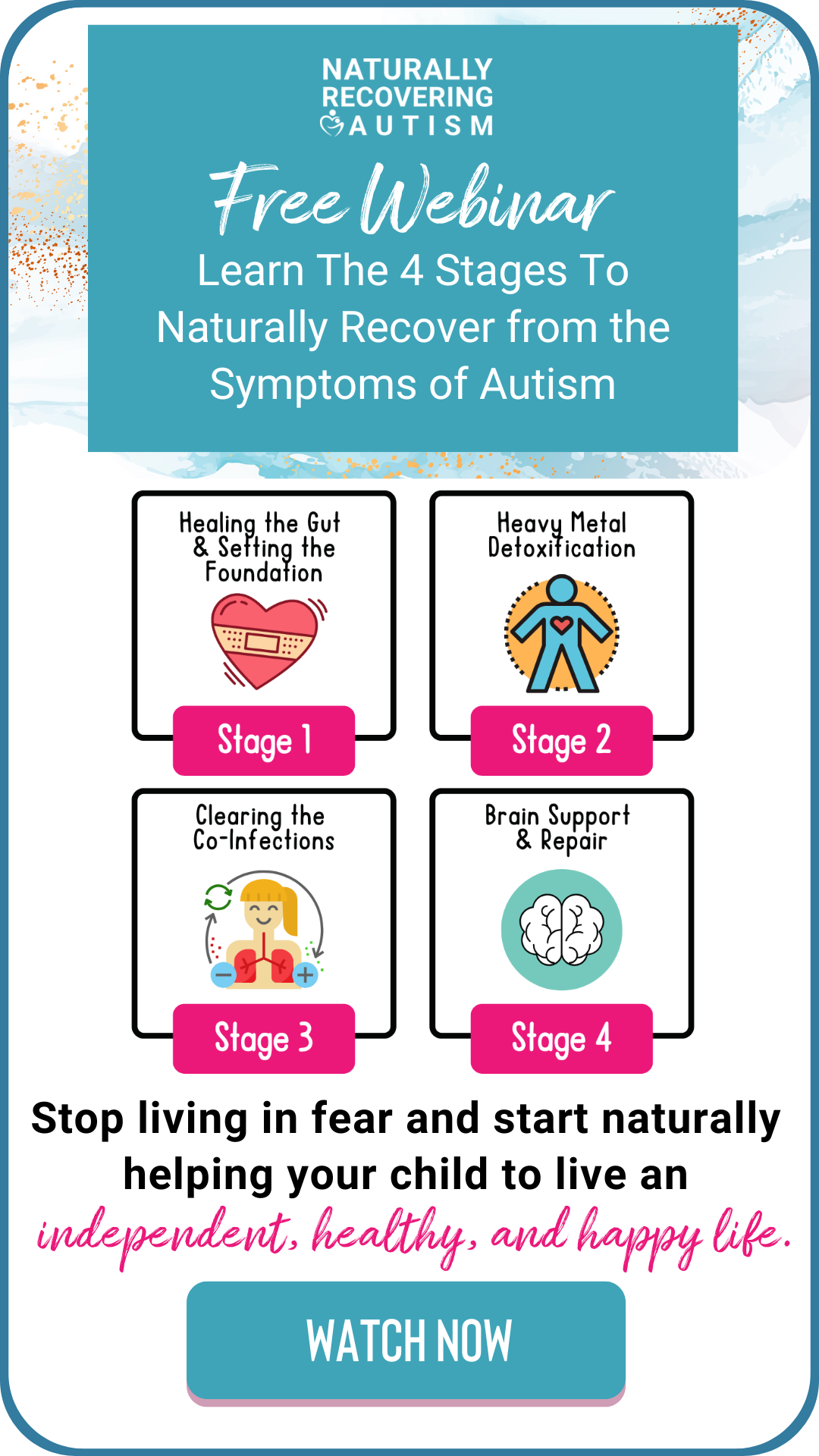
I’ll walk you through the four stages I believe are essential to supporting your child’s health:
- Healing the Gut
- Natural Heavy Metal Detoxification
- Clearing Co-Infections
- Brain Support & Repair
I’ll share what I discovered through my own journey, why I believe the order matters, and how I approach the underlying health challenges that can affect children with autism.
Stop guessing and start understanding the A-Z roadmap I developed through years of research and personal experience.
This is for informational purposes only and is not meant to diagnose or treat. Every child’s level of recovery is different. No two people are the same. It is never implied that all children will have the same outcome. Results are all based on individual biology and the work that is done. This process takes time and various steps, effort and resources need to be weighed. Our programs are intended to help you become more knowledgeable and guide you to help bring your child a better quality of life, whatever that may be. We want to help by giving great content, direction and strategies that move you forward. Nothing on this page or any of our websites is a promise or guarantee of results or future outcomes. The results on this page and any of our websites are not typical or promised. In fact, there will be people who purchase this and other programs and never put the work into implementing the strategies taught and therefore will achieve little to no results. Our more detailed earnings disclaimer, privacy policy, and terms and conditions for this program and website can be accessed via the links below. We hold ourselves (and you) to a high standard of integrity. We are cheering you on every step of the way.