School has started again, and this is a time of year when I often hear from parents who say something like:
“My child was doing so well over the summer, and suddenly things have changed.”
Maybe you’re noticing more tics. Sleep has become disrupted. Your child seems more irritable, anxious, hyperactive, unfocused, or dysregulated. Perhaps digestive issues have returned, or behaviors you thought had improved are suddenly showing up again.
When this happens, I encourage parents to ask a very important question:
What changed?
Going back to school can change a lot more in your child’s environment than we sometimes realize.
It doesn’t necessarily mean that one particular thing at school is responsible. But looking at what has changed can give you important clues.
1. A New Environment Means New Exposures
When children return to school, they suddenly spend many hours each day in a different building surrounded by many more people.
That can mean increased exposure to circulating viruses and bacteria. It can also mean exposure to different cleaning products, fragrances, dust, indoor air pollutants, and other environmental factors.
For a child who is particularly sensitive, the cumulative load may be worth considering when you notice a significant change after returning to school.
And there is another environmental factor I especially want parents to be aware of:
Water damage and mold.
2. Could There Be Water Damage or Mold in the Classroom?
Mold isn’t always obvious.
You don’t necessarily walk into a classroom and see black mold growing on a wall. There may have been a roof leak, plumbing problem, flooding, or previous water damage inside a wall, ceiling, carpet, or other building material.
If your child seems to experience a noticeable change after returning to school—particularly if symptoms improve when your child is away from that environment—it’s reasonable to investigate the building environment as one possible piece of the puzzle.
Ask the school:
Has this classroom or this area of the school ever had water damage or a leak?
If the answer is yes, you can ask what happened and how it was repaired.
Simply covering or painting over water-damaged material doesn’t address mold growth that may be present underneath. Proper remediation may require removing affected porous building materials and correcting the source of moisture.
I’ve done an entire podcast on mold where I go much more deeply into possible signs of mold exposure, testing and what parents can do when they suspect mold may be affecting their child. I’ll link to that episode here so you can use it as a guide.
3. Look at What Your Child Is Eating at School
Another big change that can happen when school starts is food.
If your child ate mostly home-prepared foods throughout the summer and is suddenly eating school meals, snacks, packaged foods, or foods brought in for classroom activities, take a closer look.
Depending upon the foods being served, children may be getting more highly processed foods, added sugars, artificial colors or flavors, preservatives, refined oils, or other ingredients they weren’t regularly consuming at home.
This doesn’t mean every school lunch is unhealthy—school menus vary considerably. The easiest way to know is to actually look at your child’s school menu and ingredient information.
If your child has particular food sensitivities, this becomes even more important.
I prefer sending children to school with a simple lunch made from whole foods whenever possible because it gives you much more control over the ingredients your child is getting.
4. Keep Lunch Simple
Healthy school lunches don’t have to be complicated.
Depending on your child’s individual dietary needs and allergies, some possibilities might include:
-
Romaine lettuce wraps with turkey and chèvre or another tolerated filling
-
Fresh vegetables with a simple dip
-
Berries or another tolerated fruit
-
Hard-boiled eggs
-
Avocado
-
Leftover organic chicken, turkey, or another protein your child tolerates
-
Seeds or tolerated nuts, if permitted by your child’s school
-
Simple gluten-free foods made from ingredients you’ve already determined work well for your child
The goal isn’t to create the “perfect” lunch.
It’s to give your child nourishing foods that you already know work well for their body, rather than introducing a lot of additional variables during the school day.
And remember that “gluten-free” on a package doesn’t automatically mean healthy. Read the ingredient label.
5. Don’t Forget About Water
Hydration is another simple piece that’s easy to overlook.
I like sending children to school with their own water in a reusable stainless-steel bottle rather than relying exclusively on bottled water or drinking fountains.
If you have concerns about the drinking water at your child’s school, ask where it comes from and whether the school has recent water-quality testing available. Depending on the age and location of a school building, there can be legitimate concerns worth investigating, including lead from older plumbing.
The important thing is to get the facts about your child’s school rather than assuming its water is either safe or unsafe.
6. Pay Attention to the Pattern
This is where parents can become excellent detectives.
If symptoms increase shortly after school begins, start keeping a simple journal.
Write down when symptoms appear, what your child ate, how they slept, whether they’ve been sick, whether symptoms are different on weekends, and whether you notice improvement after your child has been away from school for several days.
Patterns can give you clues.
For example, if symptoms consistently become stronger during the school week and improve over weekends or longer school breaks, that’s useful information for you and may also give you a reason to investigate the school environment more closely.
At the same time, remember that the beginning of school itself is a major transition. Earlier mornings, less sleep, academic demands, sensory stimulation, schedule changes and stress can all contribute to changes in how a child feels and behaves.
That’s why I like to look at the whole picture rather than assuming there’s one single cause.
When Symptoms Change, Look for What Changed
One of the most valuable lessons I’ve learned through decades of working in holistic health and through my own experience with my son is to keep asking questions.
When a child’s symptoms suddenly increase, there is often valuable information in the timing.
What changed in their food?
What changed in their environment?
What changed in their sleep?
Have they recently been sick?
Are there new exposures?
Has anything changed at school?
You don’t have to become overwhelmed and investigate everything at once. Start with the most obvious changes and work from there.
And if you’re seeing new or significant symptoms—especially new tics, substantial behavioral changes, neurological symptoms, or persistent sleep disruption—it’s important to investigate, rather than assuming they’re caused by school or an environmental exposure.
Your child’s symptoms are communication.
Instead of looking only at the behavior itself, I want you to keep asking what may be happening underneath it.
In my mold podcast, I go much deeper into mold and water-damaged buildings, signs parents can watch for, questions to ask, and ways to investigate a suspected exposure.
Free Online Event
The 4 Stage
Autism Recovery Reset
How You, as a Parent, Can Take Action Now
With an A-Z, Step-By-Step Roadmap!
1-HOUR LIVE EVENT + Q&A
THURSDAY, OCTOBER 22ND, AT 5PM PT | 8PM ET

If the time doesn't work for you, sign up anyway, and I'll send you the replay.
After watching my own son transform from struggling with severe symptoms to living a healthy, independent life, I spent years researching, learning, and developing the approach I now teach to families around the world.
In this free live online event, I will teach you what most doctors don’t even know is absolutely necessary to achieve your child’s optimal outcome to ensure their healthiest, happiest, and most fulfilling life.
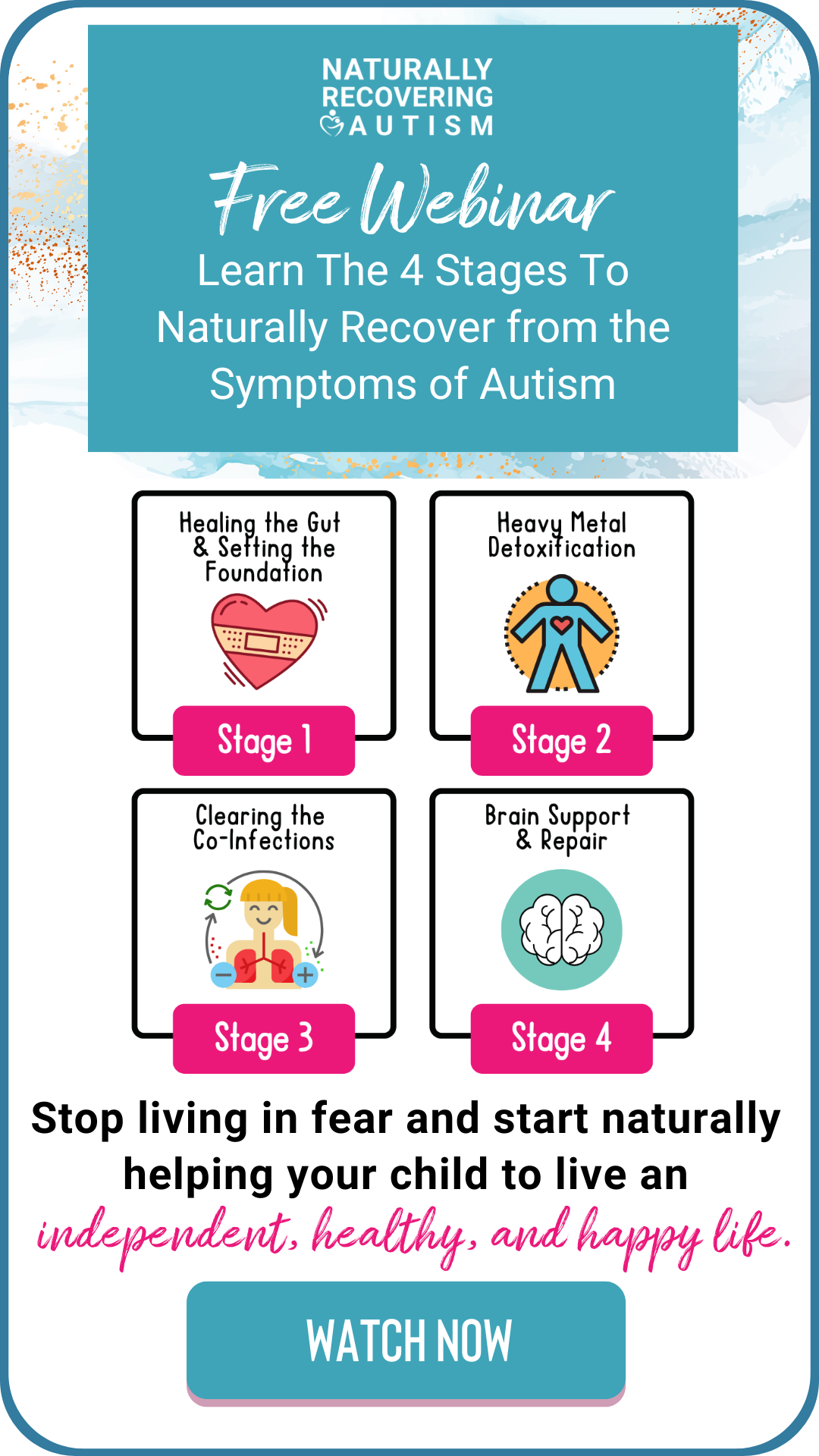
I’ll walk you through the four stages I believe are essential to supporting your child’s health:
- Healing the Gut
- Natural Heavy Metal Detoxification
- Clearing Co-Infections
- Brain Support & Repair
I’ll share what I discovered through my own journey, why I believe the order matters, and how I approach the underlying health challenges that can affect children with autism.
Stop guessing and start understanding the A-Z roadmap I developed through years of research and personal experience.
This is for informational purposes only and is not meant to diagnose or treat. Every child’s level of recovery is different. No two people are the same. It is never implied that all children will have the same outcome. Results are all based on individual biology and the work that is done. This process takes time and various steps, effort and resources need to be weighed. Our programs are intended to help you become more knowledgeable and guide you to help bring your child a better quality of life, whatever that may be. We want to help by giving great content, direction and strategies that move you forward. Nothing on this page or any of our websites is a promise or guarantee of results or future outcomes. The results on this page and any of our websites are not typical or promised. In fact, there will be people who purchase this and other programs and never put the work into implementing the strategies taught and therefore will achieve little to no results. Our more detailed earnings disclaimer, privacy policy, and terms and conditions for this program and website can be accessed via the links below. We hold ourselves (and you) to a high standard of integrity. We are cheering you on every step of the way.